Past Events
One Year After the Fall of the Assad Regime on Thursday, 12 February, 2026
The workshop looked at the broader geopolitical transformations and the domestic challenges facing Syria.
It was divided into two panels:
Panel .1.
Dr. Francesco Belcasto (University of Derby) Post-Assad Foreign Policy
Prof. Yezid Sayigh (Carnegie Middle East Center, Beirut) From militias into a national army
Dr. Marwan Kabalan (Arab Center, Doha) Syrian–Israeli Talks
Panel .2.
Ola Rifai (University of St Andrews) The Swinging identity balance and the fragile social contract
Dr. Karam al Nachar (Al-Jumhuriya) Syrian Intelligentsia in transition
Mohammad al Ashmar (university of St Andrews) roles of civil society in post conflict Syria
January 29th 14:00 to 15:30 GMT
Reinventing Conflict Analysis? Inside the First AI-Powered Knowledge Graph of Syrian Political Violence
Chair: Dr. Matteo Fumagalli (St Andrews)
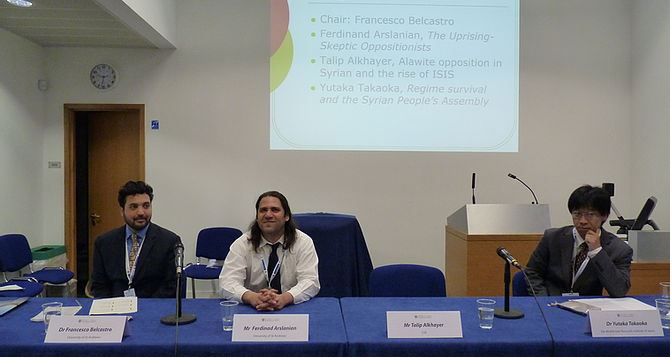
Speaker: Dr. Talip alKhayer (BrainBridge)
This webinar presents a new methodology for conflict analysis that combines large language models and graph database technology in the study of political violence. Taking the violence against Syria’s Alawites in the coastal areas as a case study.
Bio:
Talip Alkhayer is a fellow at the CSS and the founder of BrainBridge Solutions LTD, an AI-driven intelligence and research firm specialising in conflict analysis, political violence, and narrative dynamics. He holds a PhD in Politics from the University of Bath and has extensive expertise in Syrian affairs, extremist rhetoric, and identity-based violence.
His work sits at the intersection of political science and artificial intelligence, applying large language models, knowledge graphs, and open-source intelligence to analyse how conflict unfolds in the digital sphere.
Post Assad Syria : New Alliances and Foreign Policy
Sept 25, 2025
Speakers:
Dr. Marwan Kabalan
Adham Mardini
The seminar focused on Al Sharaa’s UNGA visit and Syria’s “new” foreign policy.
The Assad regime fall in less than one week, after fourteen years of bloody conflict which killed more than 600,000 people, displaced half of the Syrian population, and transferred the country into a battlefield for various state and non-state actors.
The dramatic fall of Assad poses opportunities and lots of challenges for Syrians and for the region as well. This webinar host Syrian scholars and experts to discuss the current situation and draw some recommendations.
Syria After Assad: Opportunities and Challenges
Dec 11 th 2024,
The Assad regime fell in less than one week, after fourteen years of bloody conflict which killed more than 600,000 people, displaced half of the Syrian population, and transformed the country into a battlefield for various state and non-state actors.
The dramatic fall of Assad poses opportunities and lots of challenges for Syrians and for the region as well. This webinar hostsed Syrian scholars and experts who discussed the current situation and drew some recommendations.
Ola Rifai
Omar Imady
Haian Dukhan
Nour Halabi
Baelius Zeno
Katty Hayk
Rahaf all Doughli
Mohamd al Ashmar
Commentators
Tina Zintl
Carsten Weiland
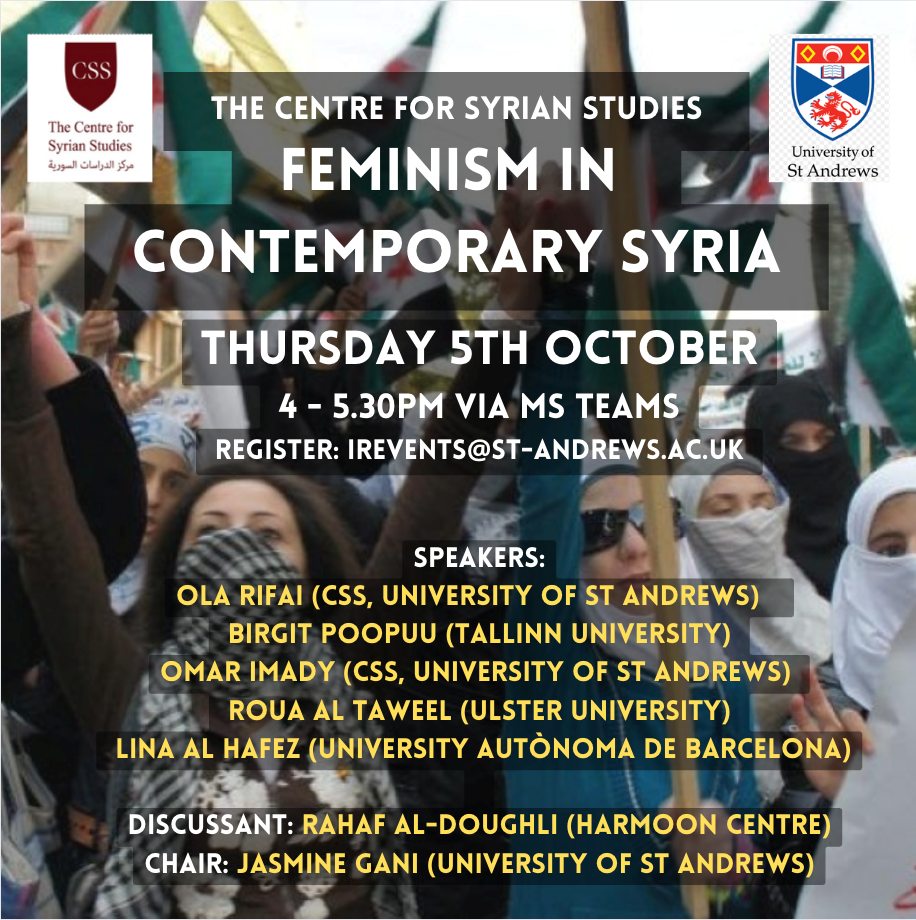
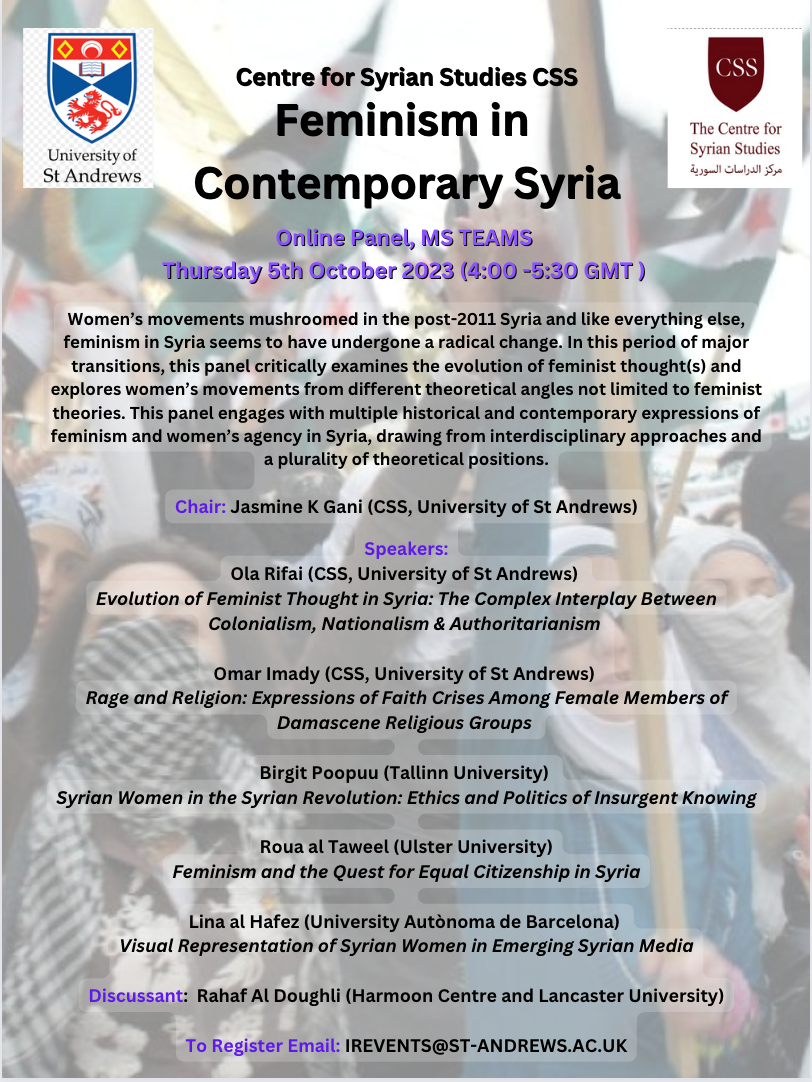
The Centre for Syrian Studies hosted a special online panel on Feminism in Contemporary Syria
Thursday 5 October 2023 16:00-17:30 UK Time via MS Teams
REGISTER VIA [email protected] TO RECEIVE THE LINK AND PASSWORD
Centre for Syrian Studies at St. Andrews will host a special webinar “Twelve Years On: the Aftermath of the Syrian Uprising” hosted by Ola Rifai, Centre Director for Outreach.
Tuesday 14 March at 1600-17:30 hrs UK time,
Join us with special guests –
Aron Lund, Middle East analyst at the Swedish Defense Research Agency (FOI). He will look at The Islamist Struggle in Northern Syria.
Carsten Wieland, senior advisor for the Middle East for the Green Party Parliamentary Group in the German Bundestag, former advisor, UN Special Representative on Syria. He will present on The diplomatic path: any way beyond a frozen conflict?
Rashad Kattan, political economist and financial crime compliance specialist. He will look at The economic outlook in the second decade of the conflict; between sanctions and reconstruction
Marwan Kalaban, Director of Political Studies at the Arab Center for Research and Policy Studies(ACRPS), Doha. He will explain The Shifting Dynamics of the Syrian Conflict: Alignments and Realignments in the Post-Ukraine War period.
USE THE LINK BELOW TO JOIN THE SESSION
Microsoft Teams meeting
Join on your computer, mobile app or room device
Click here to join the meeting
Meeting ID: 359 583 511 792
Passcode: hcAxJQ

BRISMES (British Society for Middle Eastern Studies) Conference, July 2022
The Institute of Middle East, Central Asian and Caucasus Studies in the St Andrews University School of International relations is hosting the BRISMES 2022 conference of July 2022 in St Andrews.
The Centre for Syrian Studies is part of the Institute and will have a presence, hopefully several panels on Syria and a reception and book stand.
If you would like, together with other Syria specialists known to you to organize a panel devoted to Syria, you can do so via this link: BRISMES Conference 2022
The deadline for submission of proposals is noon (GMT) 22 November 2021
February 7, 2023
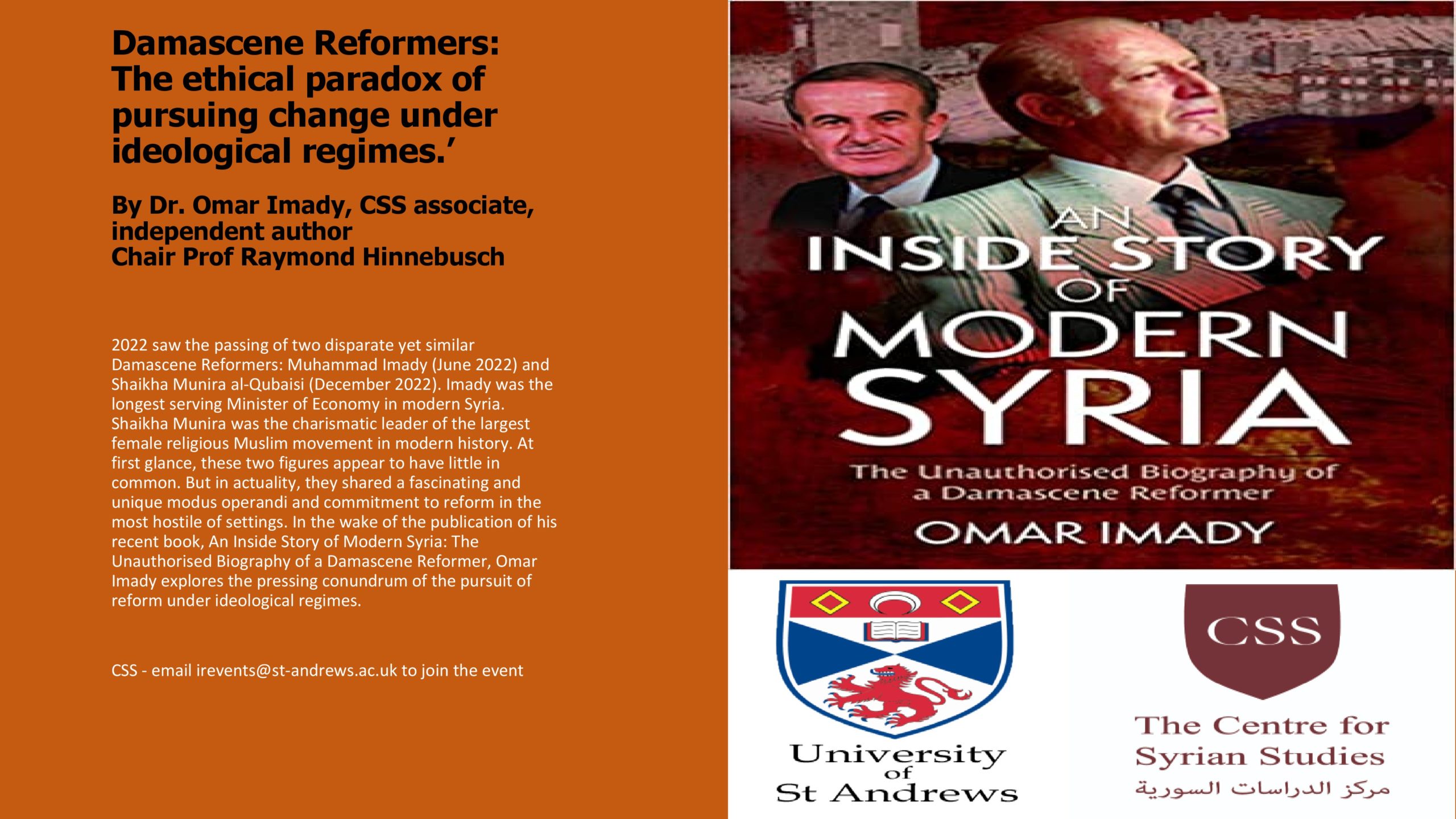
CSS hosted an online seminar titled “Damascene Reformers: The ethical paradox of pursuing change under ideological regimes”. By Dr. Omar Imady, CSS associate and independent author.
2022 saw the passing of two disparate yet similar Damascene Reformers: Muhammad Imady (June 2022) and Shaikha Munira al-Qubaisi (December 2022). Imady was the longest-serving Minister of Economy in modern Syria. Shaikha Munira was the charismatic leader of the largest female religious Muslim movement in modern history. At first glance, these two figures appear to have little in common. But in actuality, they shared a fascinating and unique modus operandi and commitment to reform in the most hostile of settings. In the wake of the publication of his recent book, An Inside Story of Modern Syria: The Unauthorised Biography of a Damascene Reformer, Omar Imady explores the pressing conundrum of the pursuit of reform under ideological regimes.
October 25, 2022
BOOK LAUNCH: The Centre for Syrian Studies and the Institute of Middle East, Caucasus and Central Asian Studies hosted a book launch for
Actors and Dynamics in the Syrian Conflict’s Middle Phase: between contentious politics, militarization and regime resilience, Routledge-St Andrews Syrian Studies Series, 2022
Speakers:
Jasmine Gani, University of St. Andrews, co-editor
Raymond Hinnebusch, University of St. Andrews. Co-editor
Rashid Kattan, Centre for Syrian Studies
Rana Khalaf, University of Manchester
Aurora Sottimano, University of Rome
Bilal Sukkar, Saferworld
JUNE 10, 2022
CSS speaks with Prof. Chris Phillips about ‘everyday Arab Identity’ in the Post-2011 Syria
The Arab Identity during the Syrian War: Less Power and more Fluidity?
The Syrian war has vehemently shaken the identity balance and seem to disrupt the pre-2011 multilayered identity (consisting of Arabism as umbrella identity under which Syrianism and Islamism follow). While state and non-state actors are manipulating Islamic and Syrian identity to construct power, the Arab identity seems to be demising. Despite the debate of the rise and death of Arabism, implications of Syrian War subject Arab identity to a new process of transformation.
Chair: Professor Raymond Hinnebusch, Director of Centre for Syrian Studies CSS
Chris Phillips: Professor in International Relations at the Queen Mary University London
Ola Rifai: Senior Fellow at the Centre for Syrian Studies CSS
APRIL 5, 2022
Mapping Kurdistan: Territory, Self-Determination and Nationalism
Dr Zeynep Kaya of the University of Sheffield speaks with CSS about her research and book, Mapping Kurdistan: Territory, Self-Determination and Nationalism.
Since the early twentieth-century, Kurds have challenged the borders and national identities of the states they inhabit. Nowhere is this more evident than in their promotion of the ‘Map of Greater Kurdistan’, an ideal of a unified Kurdish homeland in an ethnically and geographically complex region. This powerful image is embedded in the consciousness of the Kurdish people, both within the region and, perhaps even more strongly, in the diaspora. Addressing the lack of rigorous research and analysis of Kurdish politics from an international perspective, Dr Kaya focuses on self-determination, territorial identity and international norms to suggest how these imaginations of homelands have been socially, politically and historically constructed (much like the state territories the Kurds inhabit), as opposed to their perception of being natural, perennial or intrinsic. Adopting a non-political approach to notions of nationhood and territoriality, ‘Mapping Kurdistan’ is a systematic examination of the international processes that have enabled a wide range of actors to imagine and create the cartographic image of greater Kurdistan that is in use today.
Speaker: Dr Zeynep Kaya is Lecturer in International Relations at the Department of Politics and International Relations, University of Sheffield. She holds a PhD in International Relations from the LSE. Her main research areas involve borderlands, territoriality, conflict, peace, political legitimacy and gender. She has recently published a monograph entitled Mapping Kurdistan: Territory, Self-Determination and Nationalism with Cambridge University Press, is co-editor of I.B. Tauris-Bloomsbury’s book series on Kurdish studies and co-convenor of the Kurdish Studies Series with the LSE Middle East Centre. She is also an Academic Associate at Pembroke College, University of Cambridge.
Chair: Dr Jasmine Gani is Senior Lecturer in the School of International Relations and Co-Director of the Centre for Syrian Studies at the University of St Andrews.
FEBRUARY 8, 2022
Humanitarian Assistance and War Crimes
Dr Carsten Wieland and Dr Michelle Burgis
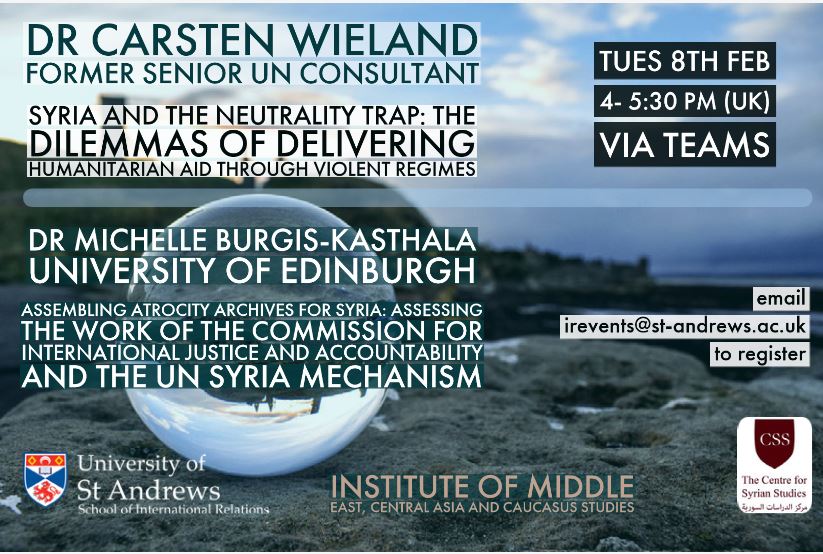
The CSS and MECACS hosted this joint presentation from Dr Carsten Wieland, scholar, German diplomat, former senior UN consultant, and Middle East and conflict expert with high-ranking mediation experience, and Dr Michelle Burgis-Kasthala of the University of Edinburgh,
Dr Wieland will present his book Syria and the Neutrality Trap: The Dilemmas of Delivering Humanitarian Aid through Violent Regimes.
The Syrian war has been an example of the abuse and insufficient delivery of humanitarian assistance. According to international practice, humanitarian aid should be channelled through a state government that bears a particular responsibility for its population. Yet in Syria, the bulk of relief went through Damascus while the regime caused the vast majority of civilian deaths. Should the UN have severed its cooperation with the government and neglected its humanitarian duty to help all people in need? Decision makers face these tough policy dilemmas, and often the “neutrality trap” snaps shut.
Dr Burgis-Kasthala will present on ‘Assembling Atrocity Archives for Syria: Assessing the Work of the Commission for International Justice and Accountability and the UN Syria Mechanism’.
What types of material are being archived in the midst of Syria’s conflict? Who is gathering this material and for what ends? How might this material inform future criminal trials or broader transitional justice mechanisms? This talk draws on ethnographic research into two key archival actors in Syria’s war to reflect on avenues for redress and responsibility through such activities.
Watch the event here
NOVEMBER 4, 2021
The Question of Religion in the Syrian Constitutions
Dr Rim Turkmani – LSE

The Centre for Syrian studies together with MECACS Presents – The Question of Religion in the Syrian Constitutions
This lecture will discuss the question of religion within all the Syrian constitutions since the first ever attempt to write a constitution for Syria exactly a century ago and until the current constitution. It will go beyond the constitutional provisions and examines the debates and discussions surrounding the question of religion as recorded in the debates of the constitutional assemblies and in the public debate. It will discuss how the debate around the question of religion took on different dimensions depending on the context of the time, and the social and political climate in which the constitutional argument took place.
Dr Rim Turkmani is the principal investigator of the LSE based research project Legitimacy and citizenship in the Arab world project.
She is also the research director of the Syria conflict research programme at the Conflict and Civil Society Research Unit at the London School of Economics and Political Science.
Her policy-oriented research work focuses on the political economy and governance in Syria and the local drivers of the conflict and their relation to external dynamics. She is member of the Women Advisory Board to the UN special envoy to Syria.
Watch the event here
JULY 21, 2021
Syria’s Trajectory Before and Since the Uprising: New Achievements, Celebrations and Farewells (recording available)
Programme:
2:30-2:40 Welcome and Introduction, Raymond Hinnebusch, University of St. Andrews
Two presentations will examine current consequences of the Syrian conflict as documented in the recently successful Ph.D theses by two of our students.
2: 40-3:00 Tamara al-Om, University of St. Andrews, ‘The continuing resistance of Syria’s oppositional civil society’.
3:00-3:20 Ferdinand Arslanian, Unversity of St. Andrews, “Explaining Syria’s Coping with Economic Sanctions: The Interaction of International and Domestic Factors”.
3:20-3:45 Farewell to Dr Omar Imady:
We will also hear from Omar Imady, the long-time deputy director of the Centre, who is leaving his role here for other endeavours. We want to wish him well and hear about his current and future projects, in particular: The Unauthorised Biography of a Damascene Reformer, an exploration of Syria’s recent history through the prism of the experience of Dr. Muhammed Imady, former Syrian economy minister; and When Her Hand Moves, a collection of novellas.
3:45- 4:00 Discussion
Syria’s Trajectory Before and Since the Uprising
JUNE 25 2021 Social Change in Syria: Family, Village and Political Party By Dr. Sulayman Khalaf Book Launch
Social Change in Syria: Family, Village and Political Party By Dr. Sulayman KhalafProgramme of Book Launch
Friday 25 June 2021 14:00 UK Time
- 14:00-05 Welcome and Introduction: Raymond Hinnebusch and Maria Kastrinou
- 14:05-14:20: panel on the contribution of the book to disciplines studying the Middle East Maria Kastrinou: anthropology; Ray Hinnebusch: historical sociology; Abdul Nabi Isstaif: The book as a counter to Orientalist views of the Middle East; Chris Davidson, contributions of the book to Middle East studies
- 14:20-14:30: Sulayman Khalaf and Barbara Hayward: the method and challenges of writing the book.
- What the book tells us about Syria 14:30-14:40: Dawn Chatty on the books insights into the pre-Ba’th Raqqa tribes turning into cotton shaykhs; 14:40-50 Paul Anderson: What the book tells us about the tribes and Aleppo merchant connection; 14:50-15:00 Haian Dukhan: What the book tells us about the interaction of the Raqqa Tribes with the rise of the Ba’th; 15:00-15:10: Myriam Ababsa: What the book tells us about Raqqa under Bashar’s neo-liberalism
- 15:10: Questions and discussions from the audience-15:30 End
April 2021
Ten years on the Syrian Uprising: Road Map to Peace? Challenges and Opportunities
Friday 2 April 2021 – 3:00 to 5:00 pm (GMT)
Via MS Teams
Introduction 3:00-3:05pm
Prof. Raymond Hinnebusch
Session One: 3:05 – 3:35pm
Chair: Dr. Francesco Belcastro
Dr. Haid Haid – Reintegrating non-state armed groups in Syria: Mechanisms, Actors, and Shortfalls.
Ibrahim Hamidi – The regional challenges towards uniting Syrian opposition.
Dr. Jasmine Gani –US and EU positions on the future of Syria.
Break 3:35 to 3:40 pm
Session Two: 3:40 – 4:20 pm
Chair: Dr. Jinan Al-Habbal
Prof. Simon Mabon – The process of de-sectarianization in Syria
Rashad Kattan –Identifying challenges facing the reconstruction of the economy.
Rana Khalaf –The potential role of civil society in state-building.
Ola Rifai -The question of national identity in post-conflict Syria and the quest to reproduce an inclusive national identity
Q and A session: 4:20 – 4:50 pm
Closing Remarks from Prof Raymond Hinnebusch
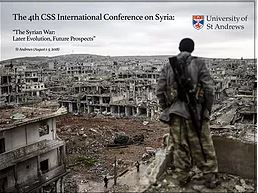
The 4th CSS International Conference on Syria: “The Syrian War: Later Evolution, Future Prospects”
1-3 August 2018 in St Andrews, Scotland
The main theme of the conference was the late Uprising period since roughly 2015, with focus on issues such as the sectarianization of the conflict; the evolution of the balance of power among groups in the conflict; governance and civil society amidst civil war in both regime and opposition areas; diplomacy and external intervention in the conflict; the Syrian diaspora; and issues of “reconciliation” and “reconstruction.”
The programme of proceedings can be found here
Link to Chrome Radio – The Syrian War; Later Evolution, Future Prospects
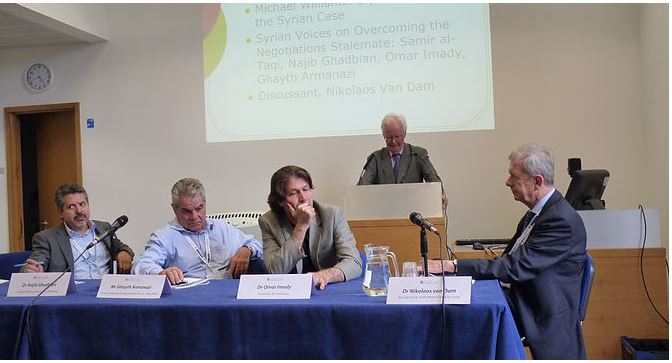
Syria: Moving Beyond the Stalemate
July 2015 – St Andrews
Keynote Address
Keynote Address – Professor William Zartman of Johns Hopkins University
Summary of Research
Responses of Participants
Responses by conference participants to the summary of findings
Recordings of Proceedings
Watch footage of the conference here
Media links
خمسة سيناريوات في سورية بينها «مناطق نفوذ» و«تقشف» النظام لحماية الساحل
Images