
Some Lessons to Learn from the Kurd’s Defeat in Northeast Syria

By Ola Rifai
2/1/2026
2026 ushered in a dramatic shift in Syria’s power balance, where massive political and military setbacks for the Kurds catalysed the end of the Rojava dream.
Apparently, the geopolitical map is being reshaped by the most influential regional and international actors in Syria today: Turkey and the U.S. Although their interests differ in many respects, they seem to align rather than clash. This resulted in the new agreement signed by the government in Damascus and Kurdish Democratic Forces (SDF) -the third since Dec 24th– establishing a permanent ceasefire and outlining the full integration of the Kurdish forces into the Syrian state. However, as for now, it is still unclear how this deal will be applied logistically; each side seems to have a very different interpretation of what ‘full integration’ means. Nevertheless, the agreement represents a concrete achievement that could pave the way for an equitable transition and, hopefully, a stable, democratic Syria.
At this critical juncture, key components of Syria’s religious communities should take a moment to reflect and draw lessons from the Kurds’ experience. Chief among them is the axiomatic reality that relying solely on foreign allies is unsustainable. As Henry Kissinger once said, ‘America has no permanent friends or enemies. Only interests. This principle, indeed, applies to all actors involved, not only to the U.S.
Lessons for Druze and Alawites
1- Separation and self-determination are not plausible in the Syrian context. Neither geography, demography, nor history facilitates this. And also, the lack of economic assets and a coherent model of governance would not support the feasibility of an independent political entity for the Alawites in the Coast, or a Druze state in the south.
In the same token, the frequent invocation of the so-called self-determination or al haq fi takrir al masyr, which has been used by political entrepreneurs and activists, is legally inaccurate in the Syrian context. In international law, the concept of self-determination is traced back to the establishment of the League of Nations and primarily applied to colonised peoples. The term remains elusive, though, as to how to identify a people, and what defines the scope of the right? Under international human rights law, a people refers to the population of a nation. In Syria’s case, that means the Syrian people as a whole. The coastal areas include Alawites, Sunnis, Christians, and Turkmen. In Sweida, the population consists of Druze, Bedouin (Sunnis) and Christians. And this raises the question of who can claim exclusive self-determination in such diverse regions.
2- Semi-autonomy and federalism do not necessarily lead to democracy nor indicate social and political inclusion. It might lead to the exact opposite; such arrangements risk obstructing democratic transition. The most successful federal systems in the world have emerged under vastly different historical, geographical, and institutional conditions. For instance, the state of Texas alone is three times larger than Syria. And there are many other examples in the United States, Canada, and Australia. Federalism in each of these countries was designed to resolve historical conflicts rather than manage post-conflict fragmentation. In the current Syrian context, federalism is not the solution; it risks deepening the crisis, and while on the one hand it might deliver a tangible stability for the short-term, it will absolutely result in more fragmentation for the long-term because myriad sectarian armed militias continue to operate independently, which would divide the already divided communities and fuel sectarianism.
3- Transforming religious communities into a polarised political entity has fatal consequences. Political entrepreneurs who bet on sectarian radicalisation ultimately undermine the very goals of protection and empowerment they claim to pursue, as they trap members of their community in a cycle of mistrust and a security dilemma.
4- The all-or-nothing logic will only cause further harm and will push the two communities – Alawite and Druze – into a corner. Leaders should shift their maximalist political visions and seek achievable objectives, such as local security arrangements and civil administration.
For the Government in Damascus:
Since the rebel forces took control of Damascus last year, the new leadership has repeatedly emphasised national unity and is consistently invoking the slogan Suriya wahidda muwahhada, one unified Syria. While military gains are crucial, they are insufficient on their own. The rapid advances in the northeast generate political momentum, but they must be accompanied by careful governance.
At this critical moment, four steps are essential to take:
1 – Safeguarding the ceasefire; in such a highly polarised and sectarian environment, the state should be responsible for de-escalation, and avoiding provocation is crucial.
2- Ensuring inclusion: military gains must be matched by a genuine socio-political inclusion, representation, participation, and transparency. There is an urgent need for a serious national dialogue, one that is substantive and inclusive, not a symbolic one-day gathering like the flawed process held in February 2025.
3- Trust-building: This is a crucial ingredient and a foundational element in any post-conflict transition. There is a crisis of trust between the various sectarian communities in Syria on the one hand, and between citizens and the state on the other hand. Rebuilding trust is a multifaceted process embedded in state-building, institutional reform, and the relationship between the state and civil society. The current leadership should address the root causes of the mistrust and rebuild state-society relations.
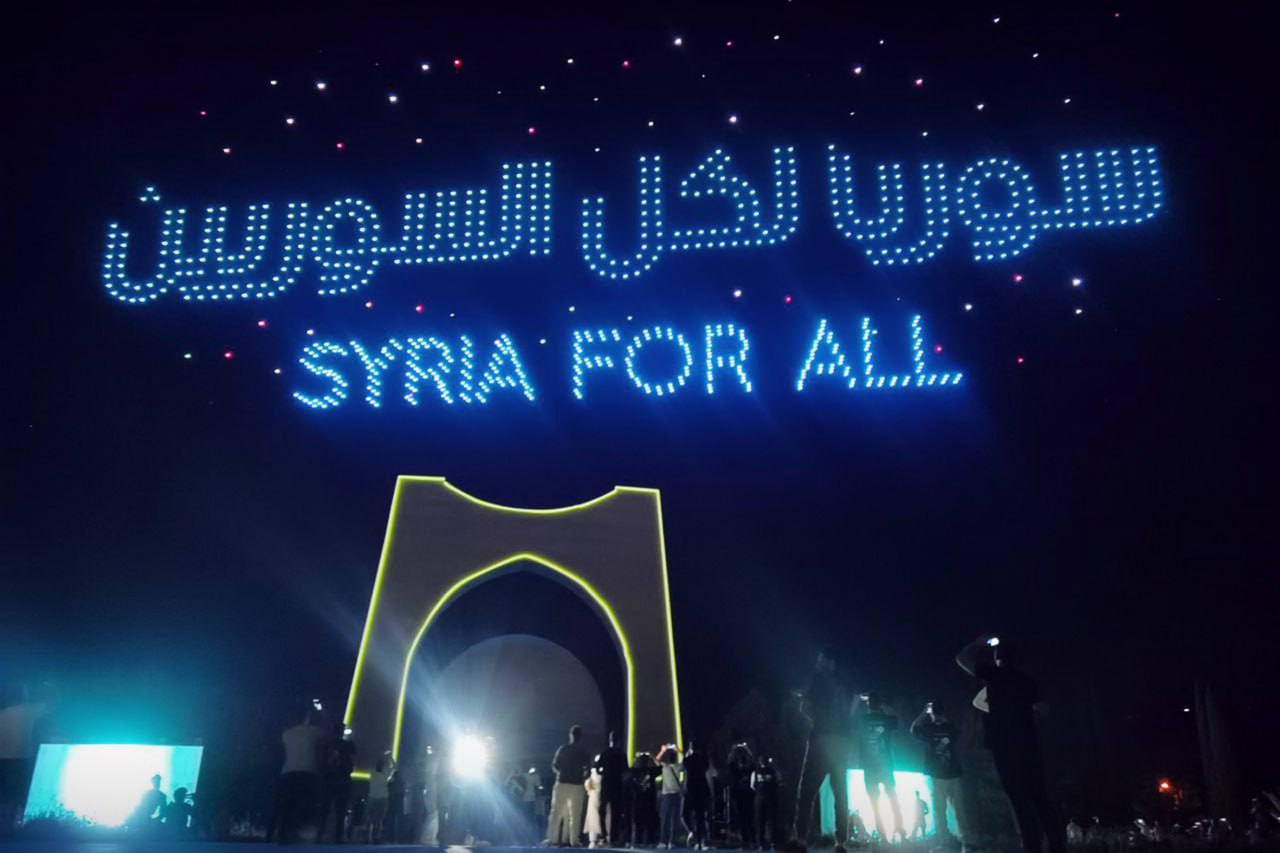
The image accompanying the article shows drones over Damascus during celebrations marking the launch of Syria’s new visual identity in July 2025. The drones lit up the Damascus sky, forming the sentence “Syria belongs to all Syrians.” Although current realities on the ground may seem far removed from this vision, the possibility of achieving it remains closer than many might think. There is still a viable opportunity for social cohesion if the various Syrian factions think rationally and realise that protecting any one religious community requires being part of the nation as a whole. The pursuit of independent sectarian entities would instead lead to consequences of apocalyptic proportions.
photo source: SANA