
Syria: Between the First Republic and the Third, what is Lost?

By Ola Rifai
04/17/2026
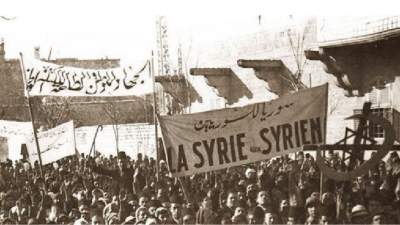
Eighty years ago today, the First Syrian Republic was established, and Syria emerged as a distinct political entity on the new map of the Arab world. The complex context in which the First Republic emerged was marked by anti-colonialism and high nationalism in the wake of WWII, as well as shifting alliances in the regional and international spheres. Syria’s statesmen of that time belonged to the upper class of urban areas who were mostly educated at prestigious schools of Istanbul or the American University in Beirut, such as Lutfi al Haffar, Shukri al Quwatli, Hashem al Attasi, Saadallah al Jabri, Khalid al Azzam, and Faris al Khoury. They all had a long history of struggle against colonial powers and had expansive aspirations for Syria. More importantly, they faced a formidable task after the last French soldier walked out of Syrian soil on April 17th, 1946: that is, state-building and nation-building. Yet, alas, they had little time to pursue this aim as a series of military coups d’état took place. Husni al Zaim initiated the first coup in March 1949, overthrowing the government of Quwatli.
Faris al Khouri, the speaker of the parliament at that time, warned al Zaim of the implications of such a coup, and told him fiercely Husni, you have allowed the khaki [referring to military men as the colour of their costume was khaki] into the government, and they will not get out.
Al Khoury was absolutely right, since that day, military men dominated the political landscape in Syria with varying ideologies (once the Nationalists 40s and 50s, then the Ba’athists 60s and 70s, and later the Islamists of 2024). Syria’s short-lived political experiment was effectively undermined by officers pursuing power. Amid this struggle, the First Republic collapsed, state institutions remained fragile, and questions of identity(s) remained unresolved.
Over a decade thereafter, in March 1963, the Second Syrian Republic, a Ba’athist one, was born, bringing massive transformations across the social, political, and economic spheres. Unlike the First Republic, the political establishment this time involved, mainly, military men from rural areas, driven by a socialist Ba’athist ideology. The Ba’ath Party inspired generations of Syrians and became a tool of hegemony rather than a conceptual framework. The Ba’ath that Michel Aflaq developed, rooted in liberal constructs, became nothing more than a tool to rule and to hegemonise Syria. Hafez al-Assad was the commander of this; under his rule, Ba’athification became Assadification of Syria’s Second Republic. The Ba’athist Republic evolved around Assad; state-building and identity formation were designed to secure his rule. Henceforth, Assad relied on assabiyya to build a regime, not a state.
The Second Republic collapsed with the outbreak of the 2011 revolution, and throughout the bloody thirteen-year conflict, the weakness of Syria’s state institutions and the absence of a cohesive national identity further exacerbated the conflict. The eve of December 8, 2024, marked a new chapter in Syria’s history, paving the way toward building the Third Republic or Soriyya al-Jadyda, the New Syria, the motto adopted by the current government. Islamist rebels seized power after painful, bloody years of conflict and five decades of Syria’s Assad.
Since then, the country has undergone a massive transformation at all levels, socio-political, economic and most importantly, shifting from Assadification to Islamification. The current government enjoys an absolute monopoly over state institutions and is conducting assabiyya. Once again, state-building as a structured institutional process seems to become regime-building.
For every Syrian, regardless of any political, religious or ethnic affiliation, April 17th marks a national celebration, a national pride, a collective memory of the nation. Yet, it is to a large extent a nation without nationalism. Today, eight decades after the First Syrian Republic came to light, the process of state-building and identity formation remains incomplete. The current government seems to ignore these critical issues; instead, it has been embarking on a process of regime-building. This will not help make an equitable transition. Eighty years on, Syria is still entangled in an intricate cycle of regime-building with a worsening identity crisis, whilst Syria’s new statemen manipulate identity for the sake of power. Yet, they should draw some lessons from history and bear in mind that although ideologies might be powerful enough to build a regime, they are insufficient to establish or lay the foundation for sustainable governance. Because ideologies (such as Arabism and Ba’athism) would rise and fall at a particular moment of history. Hence, solid state-building, powerful institutions and balanced identity(s) are the essential ingredients for the Third Republic. State-building is a structured institutional process that should not rely on high ideologies; nation-building is a process that first and foremost balances identity(s) rather than empowering identity (s) against the other.
Since April 17th, 1946, until today, many Syrians have lost their life for Syria, fighting against colonialism, authoritarianism, and radicalism. They are all fighting for Syria, but what is Syria for them?
During an official celebration for the first anniversary of the fall of Assad, President Ahmad al-Sharaa told a cheering crowd that his government “will restore Syria’s lost identity […] and rebuilding the nation is a responsibility we all share”. Alas, this sounds far from what is happening in reality. The government has not taken any genuine steps towards solid state-building and nation-building. It is not clear yet what a Third Republic would look like, but there are validated fears that, once again, there will be a missed opportunity to build a strong democratic Syrian Republic and a cohesive Syrian nation.
pic source SYRIATV